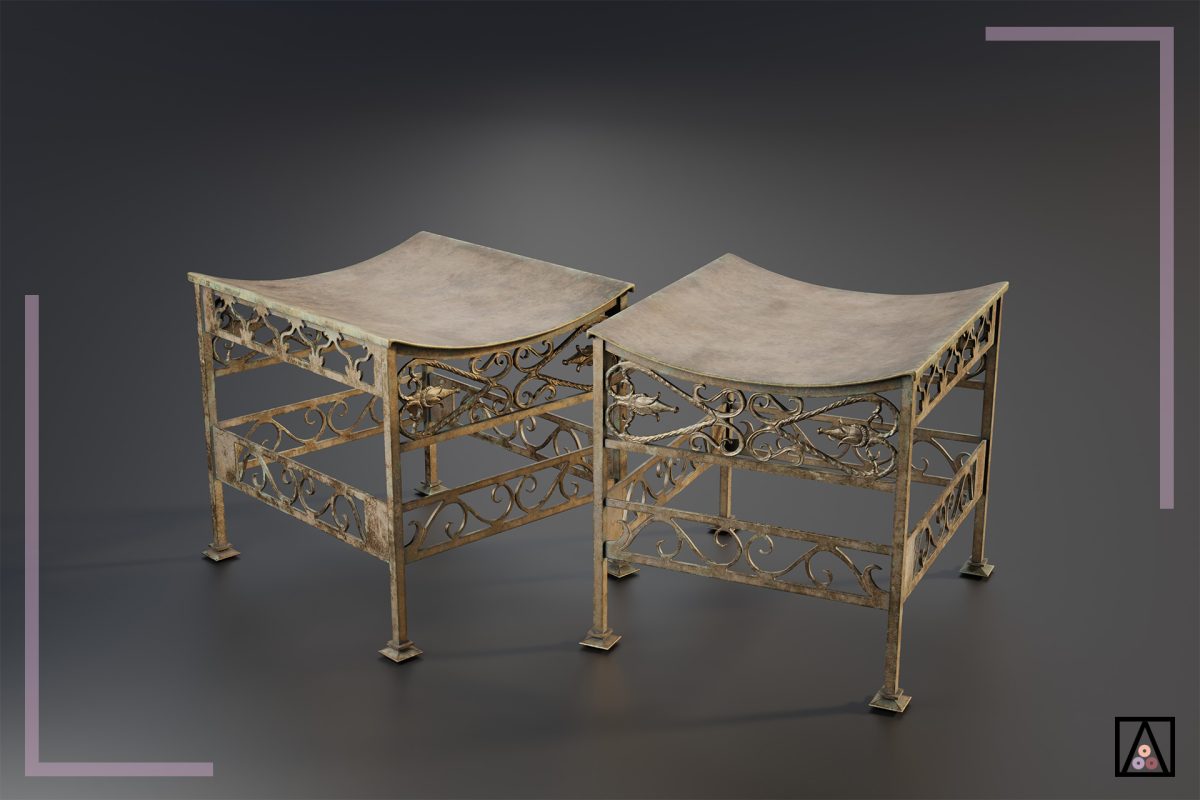
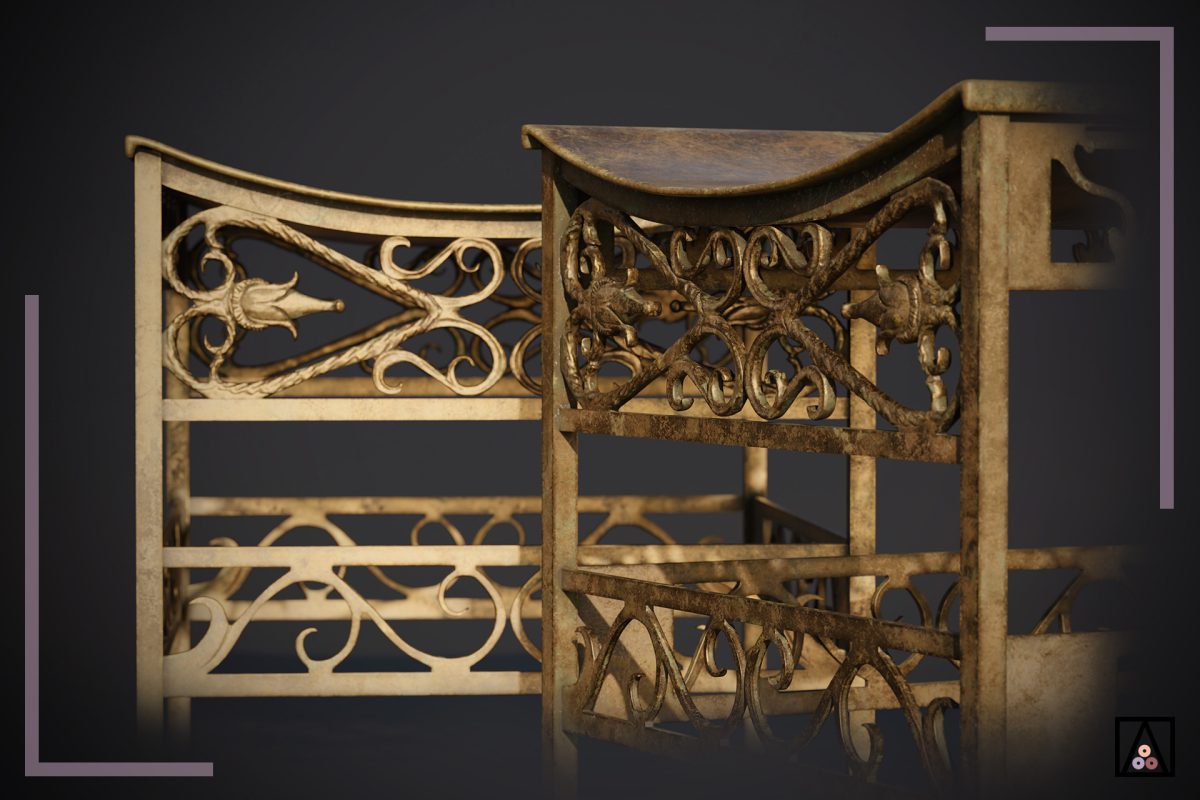
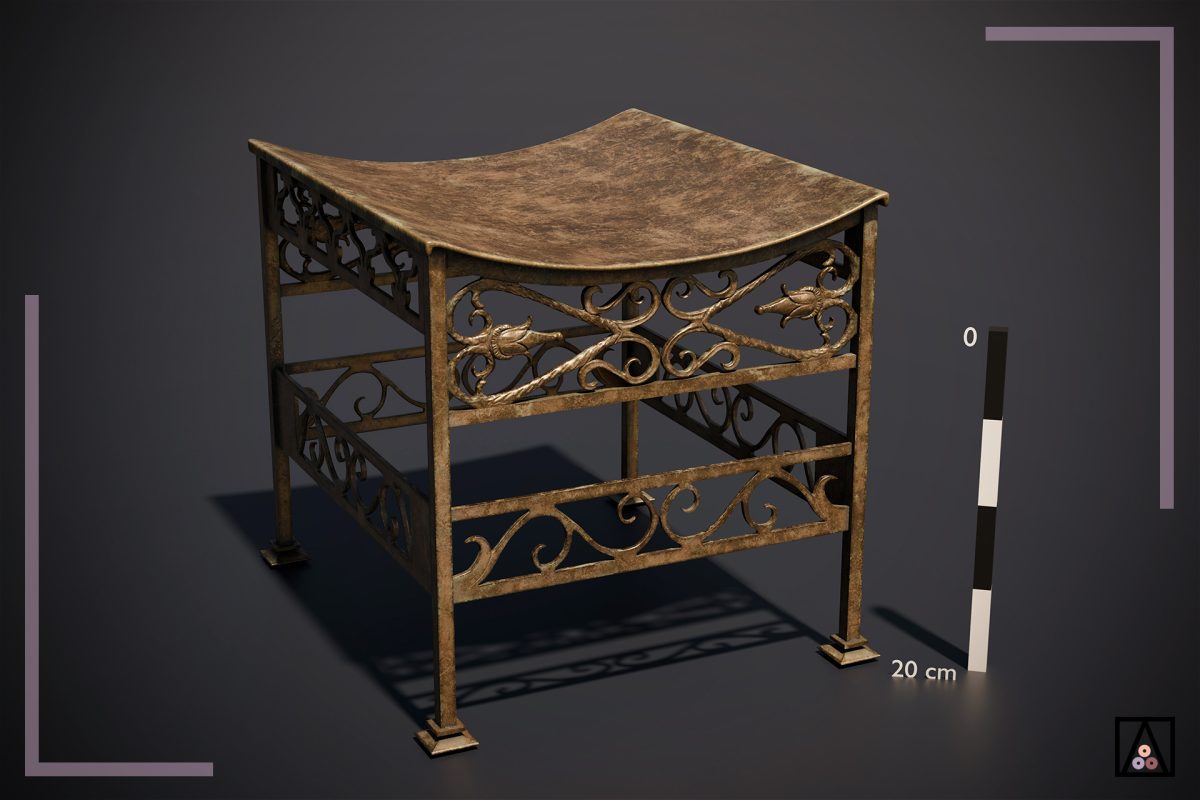
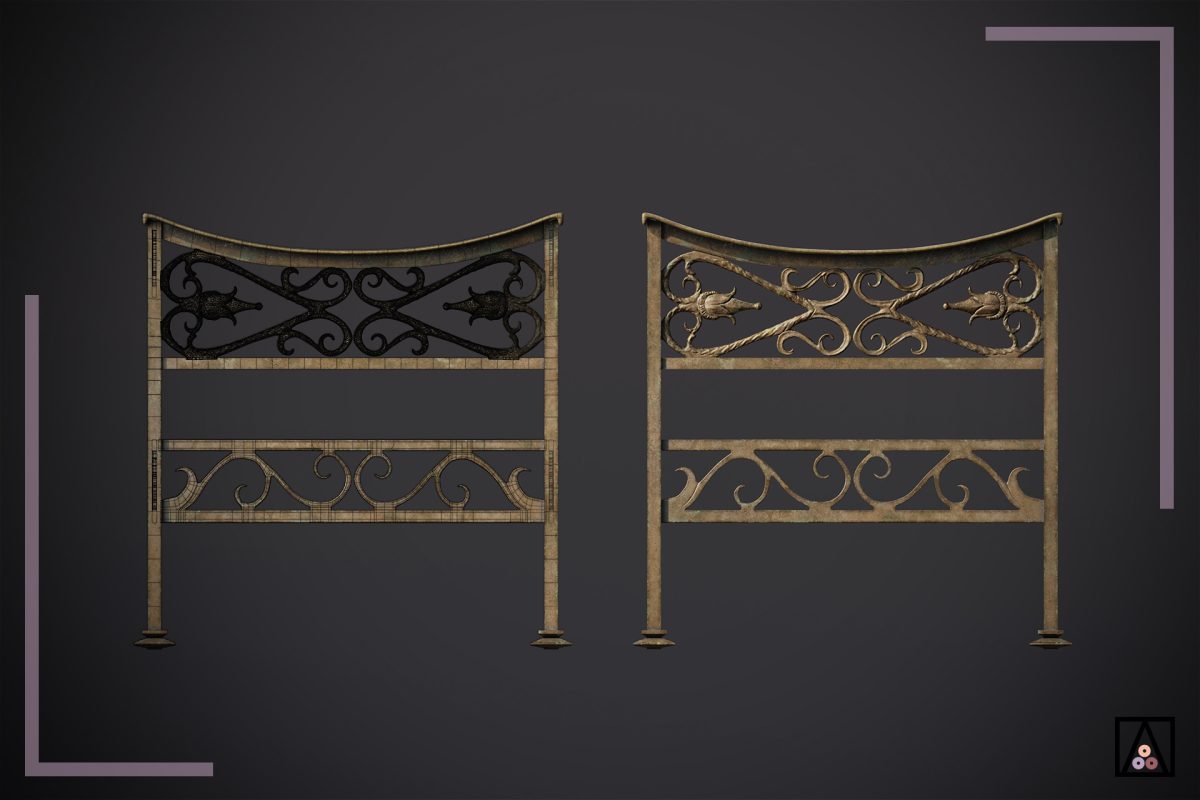
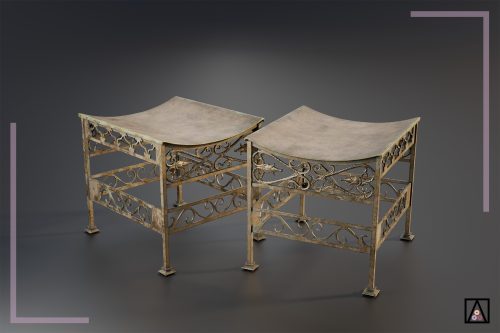
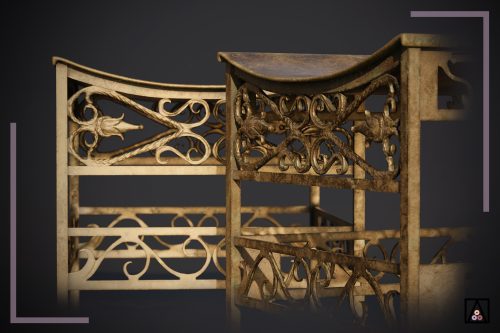
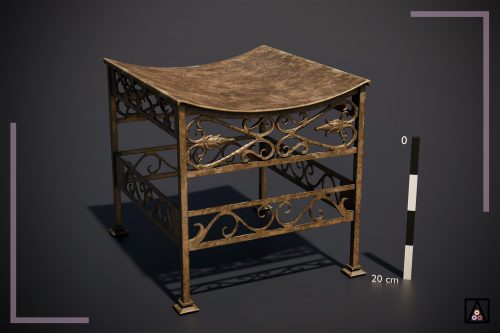
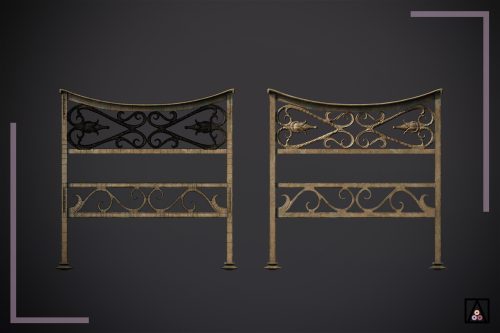


3D reconstruction of a footstool found in the city of Herculaneum, made of bronze and finely decorated.
In the Roman world, the word scabellum originally referred to a small bench or footstool, a simple piece of furniture that was very common in everyday life. Its appearance was that of a low stool, rectangular or square in shape, with four short legs. Its main function was to serve as a footrest when a person was seated in a chair (sella) or in a higher seat such as the cathedra. It could also be used as a small auxiliary stool, either to sit on briefly or as a step to climb onto the high beds that were often placed in bedrooms.
In Pompeii and Herculaneum, this type of furniture was present in houses, especially in the triclinia, where the Romans reclined to dine, and in the cubicula, the rooms for rest. There it served both a functional and a comfort role.
The most common materials were local woods, although in wealthier homes they could be decorated with inlays of ivory or bronze, and feature turned legs or simple carved motifs. Although it was a modest object, the scabellum reflects the attention that the Romans paid to domestic comfort and also to social status, since in more affluent households even a footstool could be an object of refined taste.
LOD0: 466K Poly / 773K Tris
LOD1: 156K Poly / 233K Tris
LOD2: 35K Poly / 54K Tris
LOD3: 7K Poly / 7K Tris
Game Ready Model
Formats: .FBX; .OBJ; .blend.
PBR materials (JPG/PNG)
Texture maps: Base Color, Normal Map, Metallic, Roughness, AO, Height.
Texture resolution: 1K, 2K and 4K.
Rigged: No
Animated: No
Mask for color alternatives: No
Desirée García Espinosa
CONNOLLY, P. (1979): Pompeii.
Croom, A.T. (2007). Roman Furniture. Stroud, Gloucestershire, Great Britain. Tempus.
HUNGERFORD POLLEN, John (1820-1902): Ancient and Modern Furniture and Woodwork. Published for the Committee of Council on Education by CHAPMAN AND HALL, 193, PICCADILLY
MOLS, S. (2008): "Ancient roman household furniture and its use: from Herculaneum to the Rhine", AnMurcia, 23-24, pp. 145-160.
MOLS, S. T.A.M. (1999): "Wooden Furniture in Herculaneum: Form, Technique and Function". Circumvesuviana 2. Ámsterdam: Gieben.
RICHTER, G.M.A. (1966): "The Furniture of the Greeks, Etruscans, and Romans". Phaidon. Londres.
You can download the work by HUNGERFORD POLLEN, John, at this link. https://www.gutenberg.org/ebooks/54602
More information about these pieces of furniture at:
https://catalogo.beniculturali.it/detail/ArchaeologicalProperty/1500903485