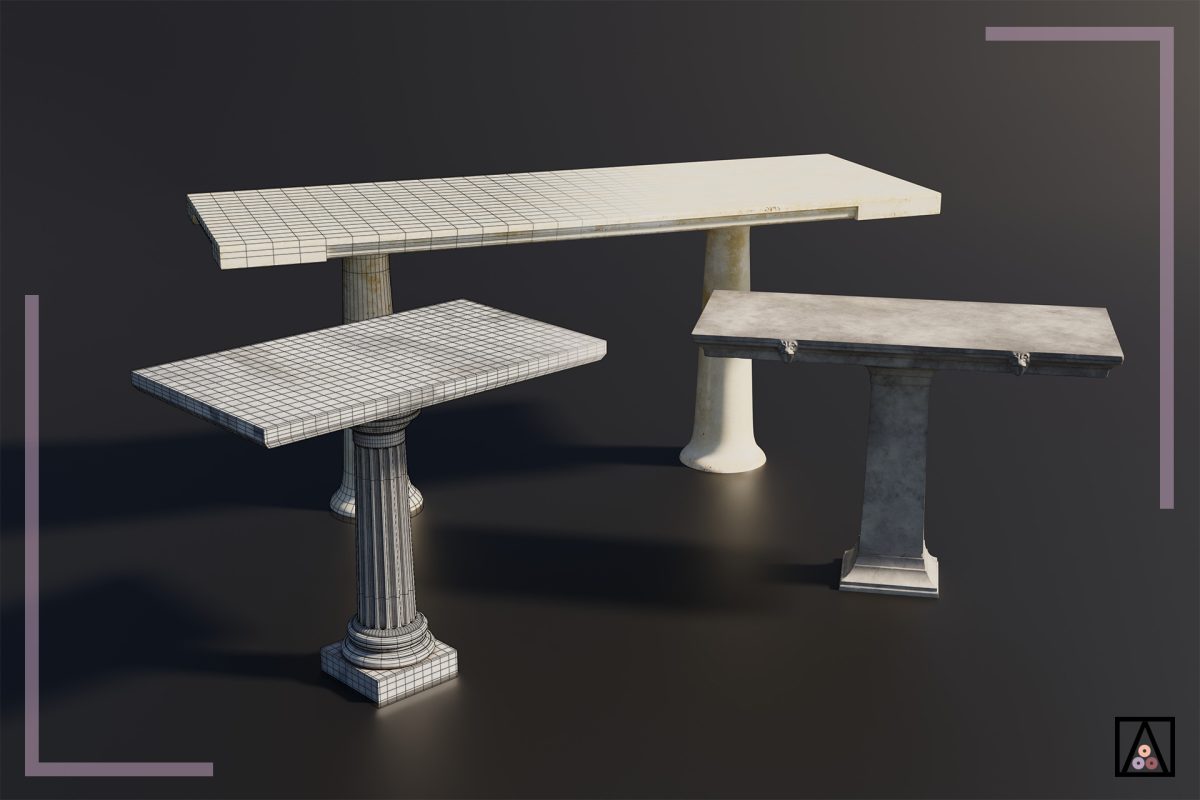
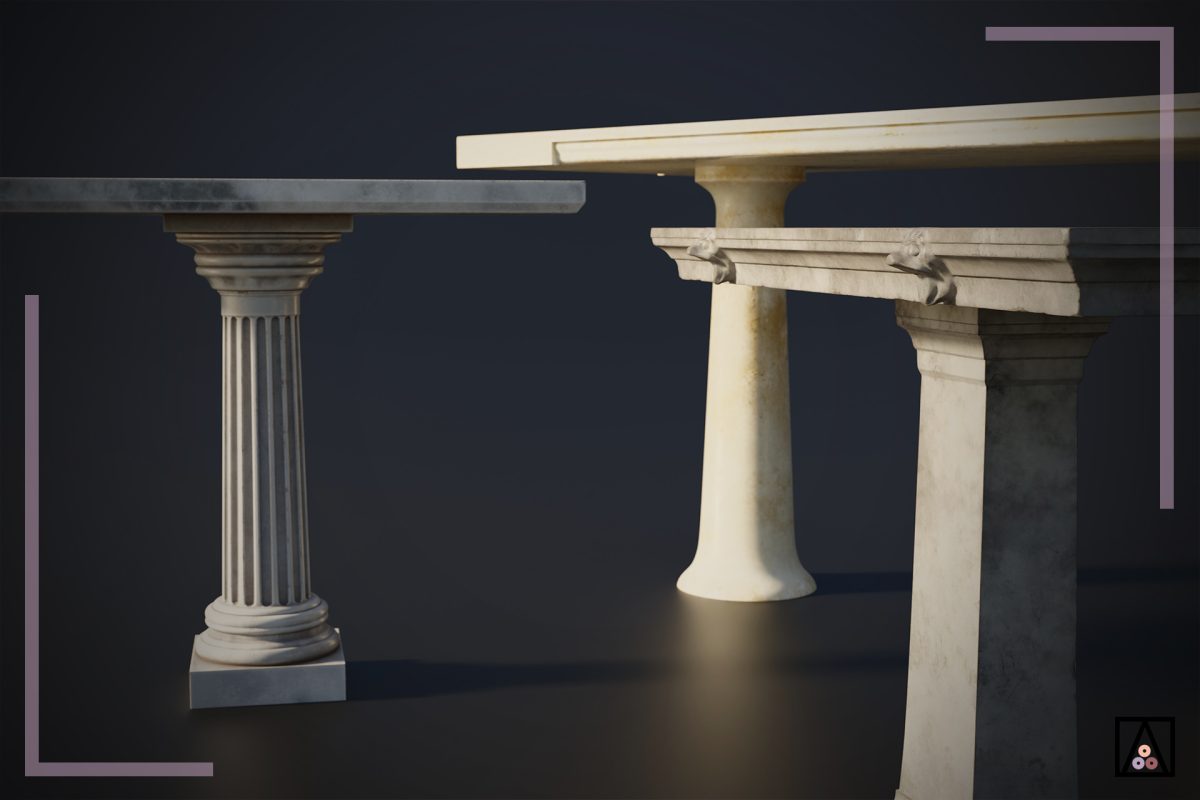
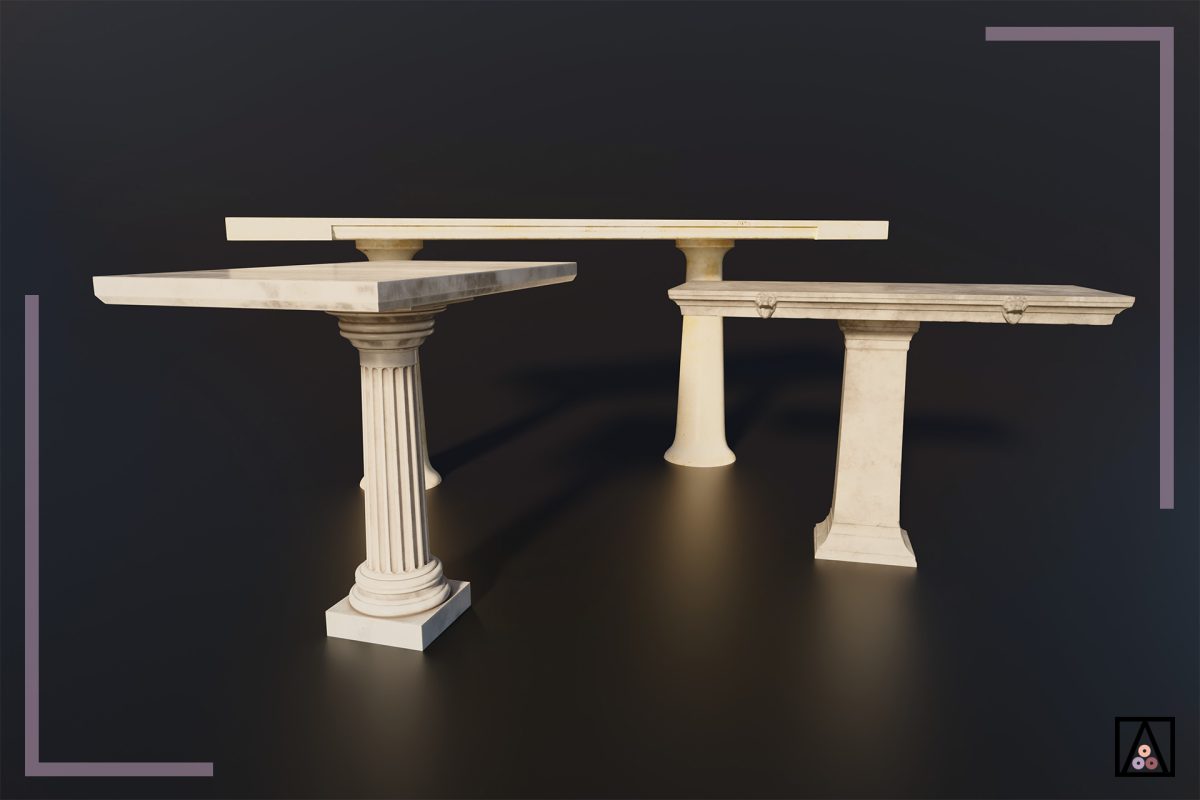
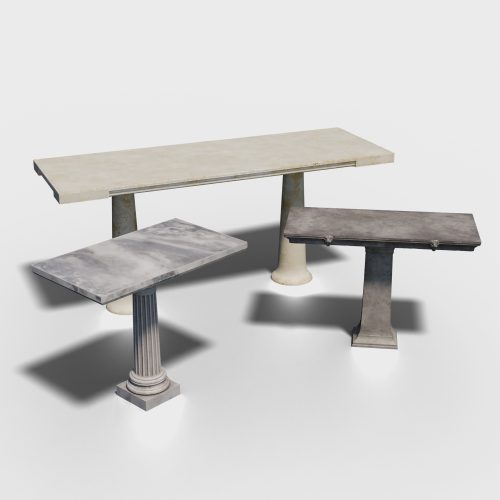
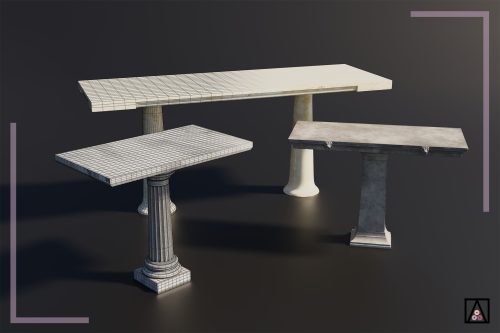
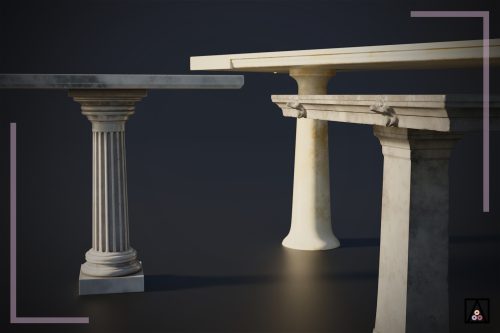
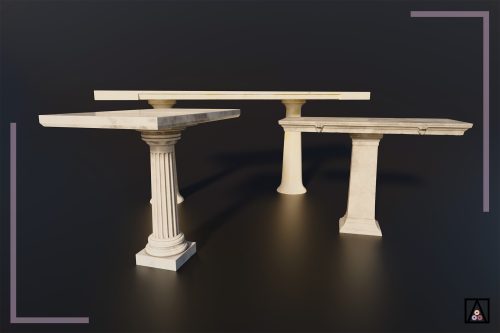


3D recreation of a set of marble tables from the archaeological site of Herculaneum in Naples, Italy.
It is possible to clearly distinguish the two types of table, the monopodium tables and those formed by two pillars. This type of table is characterised by the presence of two podiums to support the weight of rectangular tabletops. The supports may be simple architectural elements, columns or pillars, plain – as in this case – or decorated with generic grooves or mouldings, or more rarely with zoomorphic elements.
In the case of tables with a single pillar, it was very popular in Roman households as early as the 2nd century BC. The base on which the marble tops rest could be made of marble or bronze. Monopods were often placed against a wall in an enclosed environment, as in the case of the recreated find, and therefore had an essentially frontal function and view. For this reason, some of them had visible decoration, as in the case of the small dog’s heads that adorn one of these tables.
Zoomorphic sculpture was widespread in bronze production in the Vesuvius area during the 1st century AD, used as decoration on beds, doors and keys and perhaps related to the sacred value, as a guardian, attributed to this animal. The dog has a long tradition in classical sculpture with testimonies linked to funerary rather than votive fields, and in this regard, literary documentation specifically mentions three dogs that were made by great Greek artists: Myron, Lysippus and Leukon. These works may well have inspired the current models imitated by artists who worked for the Roman clientele up to the Imperial period.
Tavola 01
LOD0: 46K Poly / 93K Tris
LOD1: 11K Poly / 23K Tris
LOD2: 2K Poly / 5K Tris
LOD3: 895 Poly / 1K Tris
Tavola 02
LOD0: 119K Poly / 119K Tris
LOD1: 83K Poly / 83K Tris
LOD2: 47K Poly / 47K Tris
LOD3: 11K Poly / 11K Tris
Tavola 03
LOD0: 137K Poly / 275K Tris
LOD1: 34K Poly / 68K Tris
LOD2: 8K Poly / 17K Tris
LOD3: 1K Poly / 1K Tris
Game Ready Model
Formats: .FBX; .OBJ; .blend.
PBR materials (JPG/PNG)
Texture maps: Base Color, Normal Map, Metallic, Roughness, AO, Height.
Texture resolution: 1K, 2K and 4K.
Rigged: No
Animated: No
Mask for color alternatives: No
Desirée García Espinosa
De Carolis, E. (2007): Il mobile a Pompeii ed Ercolano. Letti, tavoli, sedie e armadi. Roma.
Mols, S.T.A.M (1999): Wooden Furniture in Herculaneum. Forn, Technique and Function. Amsterdam.
Richter, G. (1926): Ancient furniture. A history of Greek, Etruscan and Roman furniture. Oxford.
S. Feuser, Monopodia, figürliche Tischfüsse aus Kleinasien: ein Beitrag zum Ausstattungsluxus der römischen Kaiserzeit, Byzas 17, Istambul 2013.
For more information, please click on the following link: